Teorema di Stokes, scopo della vita e genitorialità

Il teorema di Stokes è una delle idee più profonde della matematica moderna, non tanto per la sua formula, quanto per la visione del mondo che suggerisce.

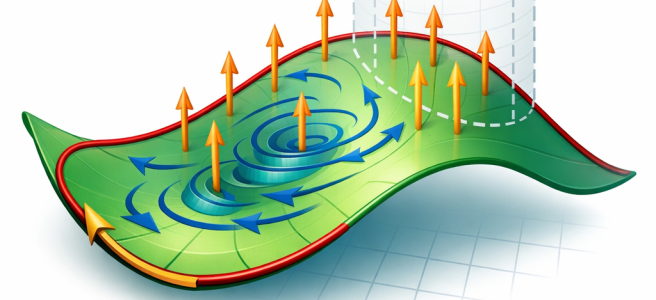
In termini semplici (e imprecisi), Stokes dice che ciò che accade sul bordo di una superficie è interamente determinato da ciò che accade al suo interno. Il comportamento globale, visibile e sintetico, non è qualcosa di aggiunto dall’esterno: è il risultato necessario delle dinamiche locali. Il bordo non comanda l’interno, ma lo rende leggibile.

Questa struttura ha implicazioni filosofiche forti, soprattutto sul piano teleologico. In Stokes, il “fine” non è una causa che guida il processo. Il risultato finale non precede ciò che accade, non lo orienta, non lo governa. Al contrario, il fine emerge come riassunto coerente di ciò che è avvenuto punto per punto. È una teleologia immanente: il senso nasce dal processo, non da un progetto.

Questo indebolisce l’idea di una finalità imposta dall’alto e rafforza una visione anti-dualista del mondo. Non c’è separazione tra meccanismo e significato, tra locale e globale, tra causa ed esito. Il senso non sta altrove: è già inscritto nelle relazioni interne. Il limite, il bordo, non crea il significato, ma lo manifesta.

Se spostiamo questa intuizione sul piano dell’esperienza umana, emerge una metafora potente per pensare la generazione e il fatto di avere figli.

Avere figli non significa realizzare uno scopo esterno, né completare un progetto, né “dare un senso” alla vita dall’esterno. Come nel teorema di Stokes, non si impone un fine: si trasmette una struttura. I figli sono uno dei modi principali attraverso cui ciò che siamo interiormente – valori, abitudini, modi di stare al mondo – attraversa un confine temporale e si rende visibile oltre la nostra vita.

In questo senso, i figli non sono un fine, ma un passaggio. Non sono il risultato da ottimizzare, ma il bordo attraverso cui il flusso della vita continua. Il senso non nasce dal controllo dell’esito, ma dalla continuità del processo.

Questo chiarisce anche perché la generazione è così strettamente legata alla finitezza. Ogni vita ha un limite. Il bordo è inevitabile. Avere figli non è un tentativo di negare questo limite, ma uno dei modi (non l’unico) di abitarlo in modo coerente: io finisco, ma ciò che ho messo in moto continua secondo regole che non controllo più.

Da qui deriva l’importanza esistenziale, ma non l’obbligo morale. Come il teorema di Stokes vale solo quando c’è una superficie con un bordo, così non tutte le vite devono necessariamente articolarsi attraverso la genitorialità. Tuttavia, questa prospettiva spiega perché, per molti, avere figli è percepito come profondamente significativo: perché rende visibile l’unità tra ciò che si è stati e ciò che verrà, senza bisogno di uno scopo imposto, di una promessa di immortalità o di una giustificazione esterna.


Nietzschean Economics

Nietzsche described the universe as the manifestation of an underlying force which he called will to power. For him, an “insatiable desire to manifest power” is the essence of the universe, and all living things have the same goal, growth. He wrote: “every living thing does everything it can not to preserve itself but to become more.” And to grow and expand, individuals establish for themselves lofty goals that they will (probably) never reach. Aiming high requires overwhelming efforts and the willingness to “risk every danger”. Pain, suffering, and being thwarted in one’s attempts to accomplish a goal are the preconditions for growth and hence an increase in one’s power. [Link to the book] 

I have always been fascinated by this idea that individuals are living in a constant desire of self overcoming and yesterday I had the chance to read an interesting debate between Richard Robb and James Heckman. In three articles (see below) they discuss if will to power is compatible with our rational choice theory.

Robb claims that economic models cannot incorporate the Nietzschean concepts and give some examples of individuals getting “utility” not only from the output of an activity but also from the exploration and the effort exerted in that activity. Agents have a “preference” for struggling. For instance, if people go to the gym, if they suffer below cold metallic machines, and they feel pain in all the parts of their bodies is not (only) because they expect a health benefit in the long run, but because they enjoy the experience. Robb also discusses the unconscious nature of human motives and the capacity of humans to rationalize the consequences of choices after a choice is made.

Heckman replied by showing how “overcoming” might be incorporated into standard utility functions and challenge Robb asking what may be the benefit for economics from investigation into the motives underlying human action.


Please note that this page contains affiliate links and any sales made through such links will reward me a small commission – at no extra cost for you. Thanks for your support!


The Pareto Principle

The Pareto principle (or the 80/20 rule) says that roughly 80% of the effects come from 20% of the causes. This principle got its name from the Italian economist Vilfredo Pareto, who showed that in 1906 approximately 80% of the land in Italy was owned by 20% of the population. He then carried out surveys on a variety of other countries and found to his surprise that a similar distribution applied.

Many natural and social phenomena follow a Pareto distribution. For instance, 20% of the pea pods produce approximately 80% of the peas, 20% of drivers cause 80% of all traffic accidents, 20% of patients use 80% of health care resources, 20% of criminals commit 80% of crimes, and 20% of infected individuals are responsible for 80% of transmissions of contagious diseases. We can observe this rule even in our daily life: we wear 20% of clothes 80% of times, 20% of items in our cart amounts to 80% total grocery bill, we use 80% of the times 20% of the apps in our smart phones and tablets.

The value of the Pareto Principle is in reminding us to stay focused on the 20 percent that matters. Of all the tasks performed throughout the day, only 20 percent really matter.

In the book 80/20 Principle (Link), you can read more about the Pareto Principle and its applications. There are interesting stories and ideas for applications from life to business. I love this principle because it forces you to reflect about your life and what you do daily. You may realize you are wasting your time in activities that are not productive, important or fun. You can start by finding out what those 80% activities are for you, and what are the other 20% of activities that produce 80% of your result, happiness and meaning. Once you have done this, double down on those efforts as much as possible and then repeat the process.


Please note that this page contains affiliate links and any sales made through such links will reward me a small commission – at no extra cost for you. Thanks for your support!